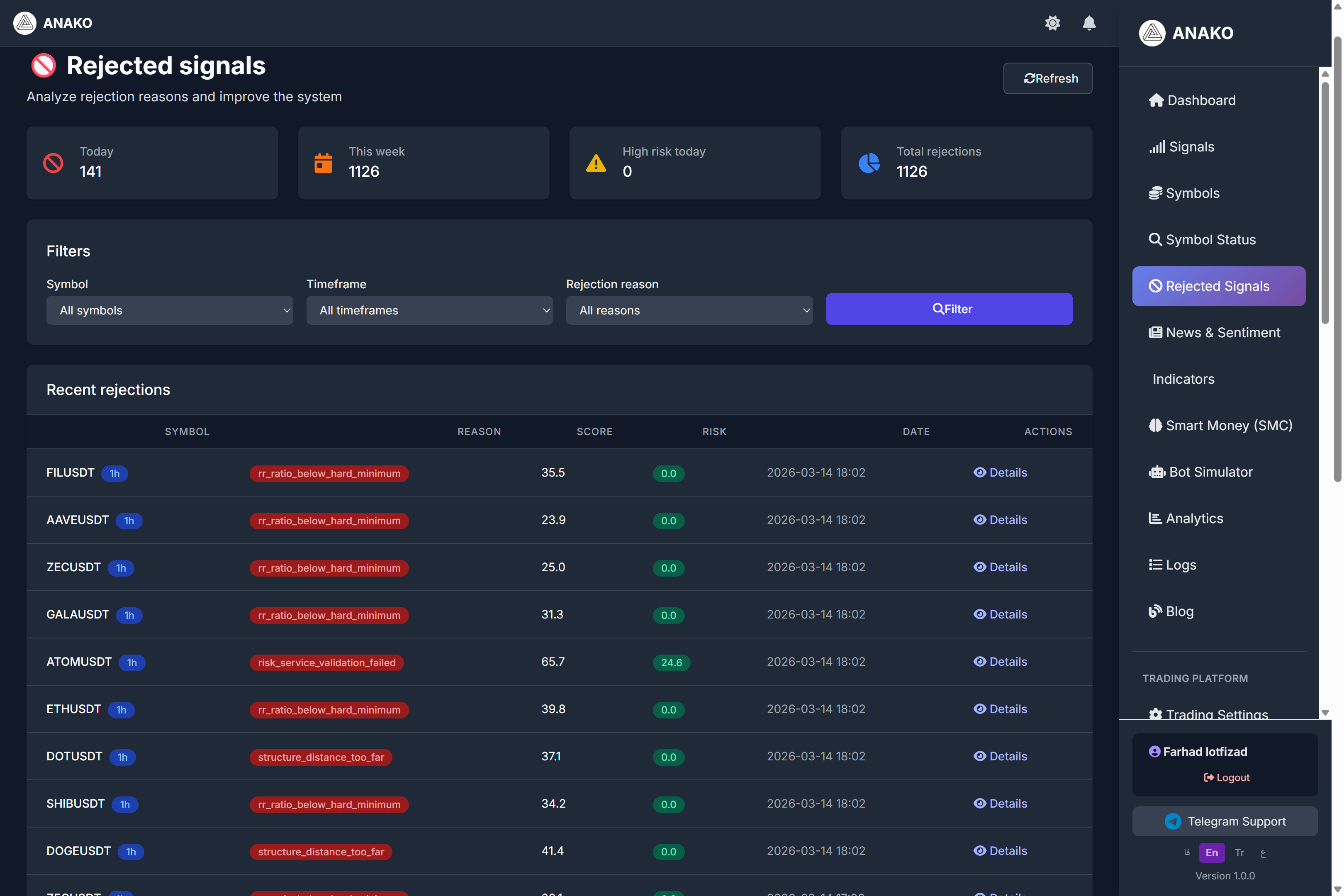
One of the advanced features of the ANAKO AI Signal platform is the ability to view and analyze signals that have been rejected by the system. This section is located in the dashboard under the name Rejected Signals.
The purpose of this section is to increase system transparency and improve the quality of signals. In this part, users can see which signals have been rejected by the algorithm and the reasons behind these decisions.
What is the Rejected Signals page?
In the ANAKO system, every trading opportunity passes through several filter stages before becoming a real signal. If a trading opportunity does not meet the required standards, the system rejects it.
These signals are recorded in the Rejected Signals section.
This information helps users understand how the system makes decisions and why some trades are not suggested.
Rejected Signals Statistics
Several important indicators are displayed at the top of the page:
Today
The number of signals rejected today.
Example:
141
This Week
The number of signals rejected during the current week.
Example:
1126
High Risk Today
The number of signals rejected due to high risk.
Total Rejections
The total number of signals rejected by the system.
These statistics show that the ANAKO algorithm filters trading opportunities with high accuracy.
Filtering Rejected Signals
It is also possible to filter the data on this page.
Users can view rejected signals based on the following criteria:
-
Symbol
-
Timeframe
-
Rejection Reason
This feature is very useful for more detailed analysis of system performance.
Recent Rejections Table
In the Recent Rejections section, the most recent rejected signals are displayed.
The information in this table includes the following:
Symbol
Trading symbol examples include:
FILUSDT
AAVEUSDT
ETHUSDT
DOTUSDT
Reason for Rejection
This column is the most important part of the table.
Here, the reason for the signal being rejected is displayed.
Some common reasons are:
rr_ratio_below_hard_minimum
structure_distance_too_far
risk_service_validation_failed
Score
The technical analysis score of the signal.
Example:
35.5
31.3
23.9
If the analysis score is low, the likelihood of the signal being rejected increases.
Risk
This column indicates the risk level of the trade.
If the trade risk is high, the system rejects it to prevent high-risk trades.
Date
The time the analysis was performed.
This shows that the system continuously monitors the market.
View Details of Rejected Signal
In the last column, the Details option is available.
By clicking this option, users can view the full details of the analysis and understand exactly why this signal was rejected.
Why Is Reviewing Rejected Signals Important?
The Rejected Signals section has several important advantages:
-
Increasing system transparency
-
Better understanding of the algorithm’s logic
-
Preventing high-risk trades
-
Improving the quality of signals
This feature shows that the ANAKO system does not only focus on generating signals but strives to select the best trading opportunities.
Conclusion
The Rejected Signals section is one of the professional features of the ANAKO platform that allows users to observe the algorithm’s decision-making process.
Using this tool, users can better understand why some trading opportunities are rejected and how the system selects quality signals.