The US Dollar Index (DXY) is a widely referenced benchmark measuring the value of the US dollar relative to a basket of foreign currencies. It serves as a critical barometer for currency strength and influences a broad spectrum of financial markets. However, understanding what DXY measures—and what it omits—is essential for interpreting its signals accurately and constructing informed market scenarios.
What Does the DXY Measure?
The DXY tracks the weighted average value of the US dollar against six major currencies: the euro (EUR), Japanese yen (JPY), British pound (GBP), Canadian dollar (CAD), Swedish krona (SEK), and Swiss franc (CHF). The weights reflect trade relationships and historical currency importance, with the euro dominating at approximately 57.6% of the index's composition. This euro dominance means that movements in EUR/USD heavily influence the DXY’s fluctuations.
Because DXY is a level index, it represents the relative value of the dollar at a point in time rather than its rate of change. Traders and analysts often complement DXY readings with momentum or rate-of-change indicators to gauge the speed and sustainability of dollar moves.
Currency-Basket Weighting and Euro Dominance
The weighting scheme of the DXY was established in 1973, reflecting trade patterns of that era. The euro’s substantial share means that any euro-related developments—such as European Central Bank (ECB) policy shifts or Eurozone economic data—can disproportionately affect the index. Conversely, currencies like the SEK and CHF, with smaller weights, exert less influence despite their economic significance.
It is important to note that the DXY omits many important currencies, including emerging market currencies and the Chinese renminbi, which limits its comprehensiveness as a global dollar measure.
Rate Differentials and Fed Expectations
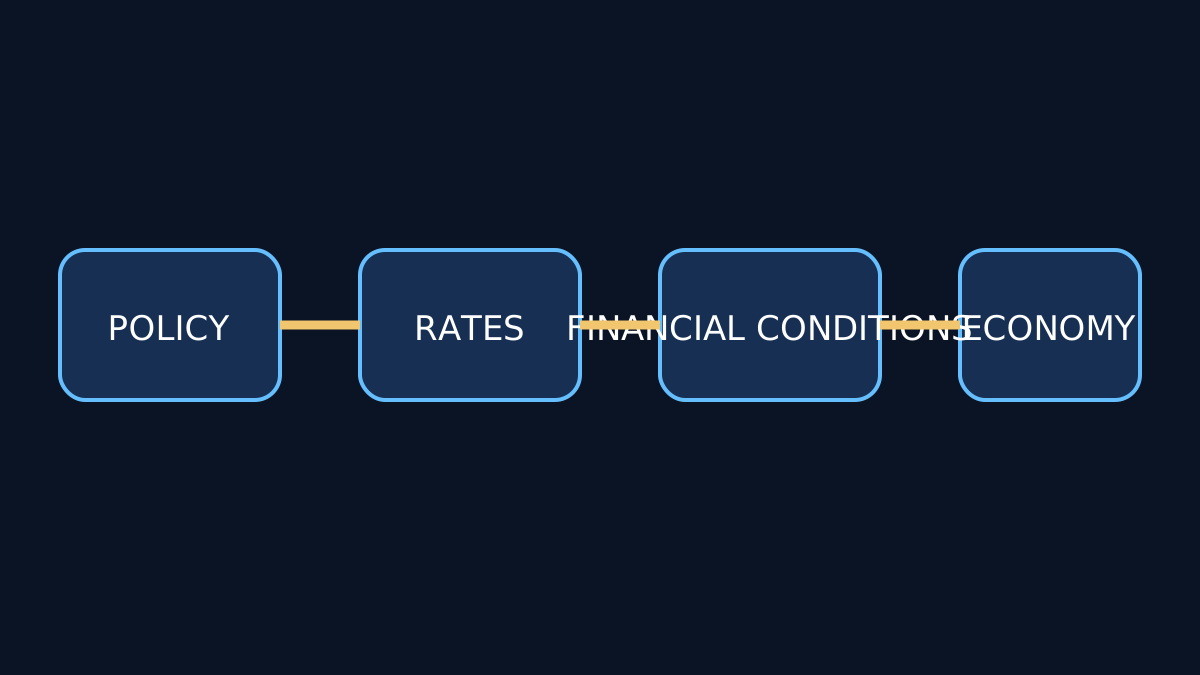
Interest rate differentials between the US Federal Reserve and other central banks are a key driver of the DXY. Expectations of Fed policy tightening tend to support the dollar, as higher US yields attract capital inflows. Conversely, dovish Fed signals or tightening elsewhere can weigh on the dollar.
However, the DXY itself does not directly incorporate interest rates or forward guidance; these must be inferred by market participants through yield curves and policy announcements.
Conditional Links to Gold, Commodities, Equities, and Crypto
The DXY’s movements often have conditional relationships with other asset classes:
- Gold: As gold is priced in dollars, a stronger DXY generally exerts downward pressure on gold prices, though this relationship can be influenced by real yields and inflation expectations.
- Commodities: Many commodities are dollar-denominated, so a rising DXY can make commodities more expensive in other currencies, potentially dampening demand.
- Equities: The impact on equities varies by region and sector. A stronger dollar can hurt multinational US companies’ earnings when foreign revenues are translated back into dollars.
- Cryptocurrencies: The relationship between the dollar and crypto assets is complex and evolving, often reflecting broader risk sentiment rather than direct causality.
Global Funding and Yield Confirmation
The DXY also interacts with global funding conditions. Dollar funding stress or shortages can amplify dollar strength beyond what fundamentals suggest. Yield confirmation—where rising US yields coincide with a rising DXY—reinforces the dollar’s trend, while divergences between yields and the DXY may signal underlying market tensions or shifts.
Divergences and Non-Dollar Crosses
Market participants should watch for divergences between the DXY and major currency pairs. For example, EUR/USD may move contrary to the DXY if euro-specific factors dominate. Additionally, non-dollar currency crosses (e.g., EUR/JPY, GBP/JPY) provide insight into regional dynamics that the DXY does not capture.
Scenario Construction Using the DXY
Constructing market scenarios with the DXY requires integrating its signals with broader macroeconomic and geopolitical contexts. Analysts consider:
- Monetary policy trajectories and rate differentials
- Commodity price trends and inflation expectations
- Global risk sentiment and funding conditions
- Technical patterns and momentum indicators
Recognizing the DXY’s limitations—such as its euro-centric weighting and omission of emerging market currencies—is vital to avoid overreliance on this single index.
Common Misconceptions and Errors
Some common pitfalls when using the DXY include:
- Assuming it reflects all global dollar movements: The DXY excludes many currencies, so it is not a complete measure of the dollar’s global strength.
- Ignoring the euro’s outsized influence: Movements in EUR/USD can overshadow other currency moves within the index.
- Confusing level changes with momentum: A rising DXY level does not necessarily imply accelerating dollar strength.
Further Reading and Resources
For a deeper dive into related topics, explore our articles on FX rate dynamics, central bank policy impacts, and commodity market linkages.
Key Takeaways
- The DXY measures the US dollar against six major currencies, with the euro dominating its weighting.
- It reflects currency levels but not directly interest rates or policy expectations.
- DXY movements conditionally influence gold, commodities, equities, and cryptocurrencies.
- Understanding divergences and non-dollar crosses enriches market analysis beyond the DXY.
- Scenario construction should integrate DXY signals with broader macroeconomic and geopolitical factors.