Automated trading tools have revolutionized financial markets by enabling rapid execution, systematic strategy deployment, and continuous market monitoring. However, their power comes with inherent risks and operational complexities that require rigorous understanding and management. This article delves into the capabilities and limitations of automation, key risks such as model overfitting and data leakage, operational pitfalls including API and connectivity failures, and a comprehensive checklist of controls and supervision practices necessary for responsible use.
Understanding Automation in Trading
Automation in trading refers to the use of computer algorithms to execute trades based on predefined criteria without human intervention. These algorithms can range from simple rule-based systems to complex machine learning models.
What Automation Can Do
- Speed and Efficiency: Execute trades faster than humanly possible, capturing fleeting market opportunities.
- Consistency: Remove emotional biases by strictly following programmed rules.
- Backtesting and Simulation: Evaluate strategies against historical data to estimate potential performance.
- 24/7 Market Monitoring: Continuously scan markets for signals and risk conditions.
What Automation Cannot Do
- Guarantee Profits: Automated systems are only as good as their underlying models and data.
- Adapt to Structural Market Changes: Models trained on past data may fail under new market regimes.
- Replace Human Judgment: Complex decisions and risk management require human oversight.
Key Risks in Automated Trading
Model and Strategy Risk
Automated trading strategies rely on models that predict market behaviour or identify trading signals. These models carry inherent risks:
- Overfitting: When a model is excessively tailored to historical data, capturing noise instead of signal, leading to poor out-of-sample performance.
- Data Leakage: Occurs when information from the future or test data inadvertently influences model training, inflating performance metrics.
Both overfitting and data leakage can give a false sense of confidence, resulting in unexpected losses when deployed live.
Backtest Versus Live Fills
Backtesting simulates strategy performance on historical data but cannot perfectly replicate live trading conditions. Differences include:
- Spread and Slippage: The difference between expected and actual execution prices due to market liquidity and order book dynamics.
- Latency and Fill Rates: Delays in order transmission and partial fills can significantly impact results.
Understanding these gaps is essential to set realistic expectations and design robust strategies.
Operational Challenges and Failures
API, VPS, Connectivity, and Stale-Data Failures
Automated trading systems typically rely on APIs to connect to exchanges or brokers, often hosted on Virtual Private Servers (VPS) for reliability. However, failures can occur:
- API Downtime or Rate Limits: Interruptions can halt trading or cause missed signals.
- VPS Failures: Hardware or network issues can disrupt operations.
- Connectivity Loss: Internet outages can prevent order execution.
- Stale Data: Delayed or outdated market data can lead to erroneous trades.
Robust monitoring and fallback mechanisms are critical to mitigate these risks.
Idempotency in Order Execution
Idempotency ensures that repeated order requests do not result in duplicate trades. This is vital in automated systems to handle network retries or API errors safely.
Risk Controls and Safeguards
Position Sizing and Limits
Proper position sizing controls risk exposure per trade and overall portfolio. Common controls include:
- Aggregate Limits: Maximum exposure across all positions.
- Daily Limits: Caps on daily trading volume or losses.
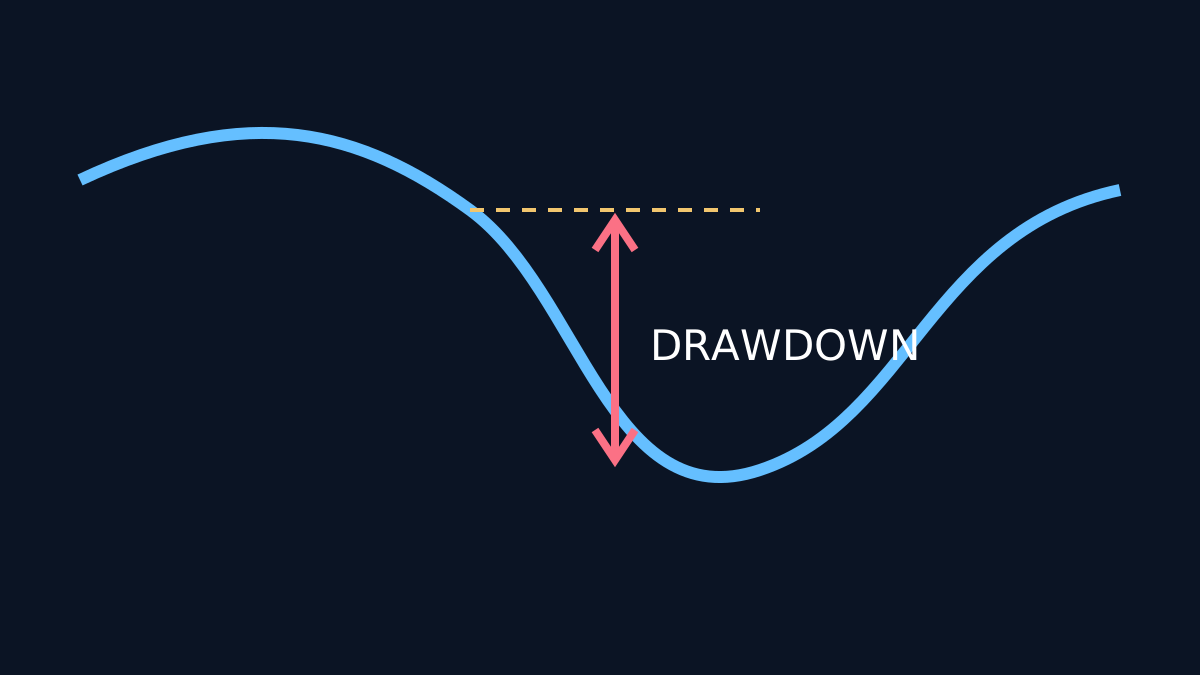
- Drawdown Limits: Thresholds that trigger strategy suspension upon losses.
Kill Switches and Reconciliation
Kill switches provide an immediate manual or automatic shutdown mechanism for trading algorithms when abnormal conditions arise. Reconciliation processes verify that executed trades match intended orders, ensuring system integrity.
Monitoring and Searchable Logs
Continuous monitoring of system health, market conditions, and trade performance is essential. Searchable logs facilitate forensic analysis and compliance audits.
Deployment Controls and Human Supervision
Deployment should follow strict version control, testing, and staged rollouts to minimize risk. Human supervision remains indispensable to interpret anomalies, intervene during emergencies, and update models in response to market changes.
Operational Checklist for Responsible Automation
- Validate model assumptions and guard against overfitting and data leakage.
- Understand and quantify backtest limitations versus live trading.
- Implement robust API and connectivity monitoring with alerting.
- Ensure idempotent order execution logic.
- Define and enforce position sizing, aggregate, daily, and drawdown limits.
- Integrate kill switches accessible to both automated triggers and human operators.
- Maintain comprehensive, searchable logs for all trading activity.
- Apply strict deployment controls including code reviews and staged rollouts.
- Establish continuous human supervision and periodic model review.
Conclusion
Automated trading tools are powerful but complex instruments that require a disciplined approach to design, deployment, and ongoing management. Understanding their limitations, recognizing key risks such as overfitting and operational failures, and implementing comprehensive controls including kill switches, position limits, and human supervision are essential to harness their benefits responsibly. For further insights, see our related articles on model risk management and algorithmic trading monitoring.