In advanced price action analysis, Fair Value Gaps (FVGs) are recognized as zones where price has moved too quickly, leaving behind areas of inefficiency on the chart. Understanding these gaps requires a foundation in candle structure, liquidity concepts, and market mechanics such as Break of Structure (BOS) and Market Structure Shifts (MSS) or Change of Character (CHOCH). This article unpacks FVGs from first principles, exploring their formation, types, and limitations in trading contexts.
Defining Fair Value Gaps: The Three-Candle Boundary
An FVG is identified by examining three consecutive candles. Specifically, it is the price range between the high of the first candle and the low of the third candle (in a bullish FVG), or the low of the first candle and the high of the third candle (in a bearish FVG), where no trading activity occurred. This gap represents a displacement in price, often caused by rapid market movement or a liquidity vacuum.
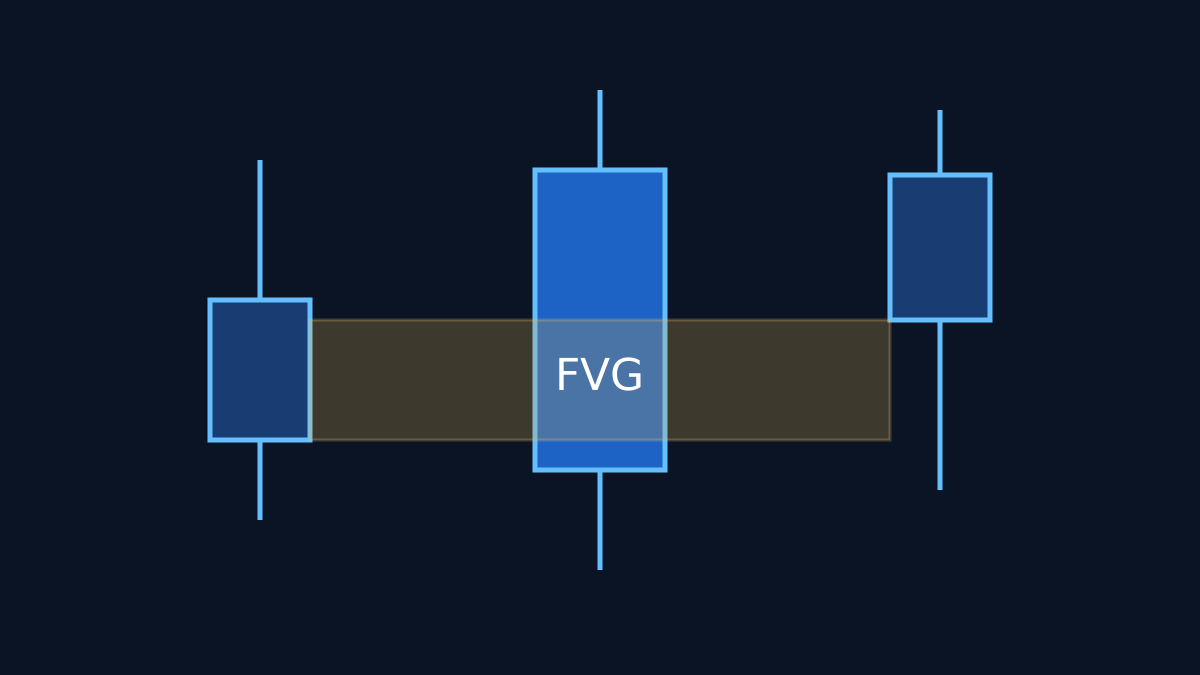
By definition, the middle candle's body does not overlap with the range of the first and third candles, creating a 'gap' in price action. This gap is interpreted as an inefficiency where the market moved too quickly, leaving behind unfilled orders or untested price levels.
Bullish and Bearish Fair Value Gaps
In a bullish FVG, price moves sharply upward, leaving a gap between the low of the third candle and the high of the first candle. Conversely, a bearish FVG forms when price rapidly declines, creating a gap between the high of the third candle and the low of the first candle. Recognizing the directionality of the FVG is essential for contextualizing its role in market structure.
Displacement and Market Inefficiency
The core mechanism behind FVGs is displacement—a swift price movement that bypasses intermediate levels, resulting in a zone where liquidity was not fully absorbed. This inefficiency often draws price back to 'fill' or 'mitigate' the gap, as market participants seek to execute resting orders or rebalance positions.
Fresh Versus Mitigated Fair Value Gaps
Not all FVGs are equal. A fresh FVG is one that remains unfilled or untested since its formation, representing a pristine inefficiency. A mitigated FVG has been partially or fully filled by subsequent price action.
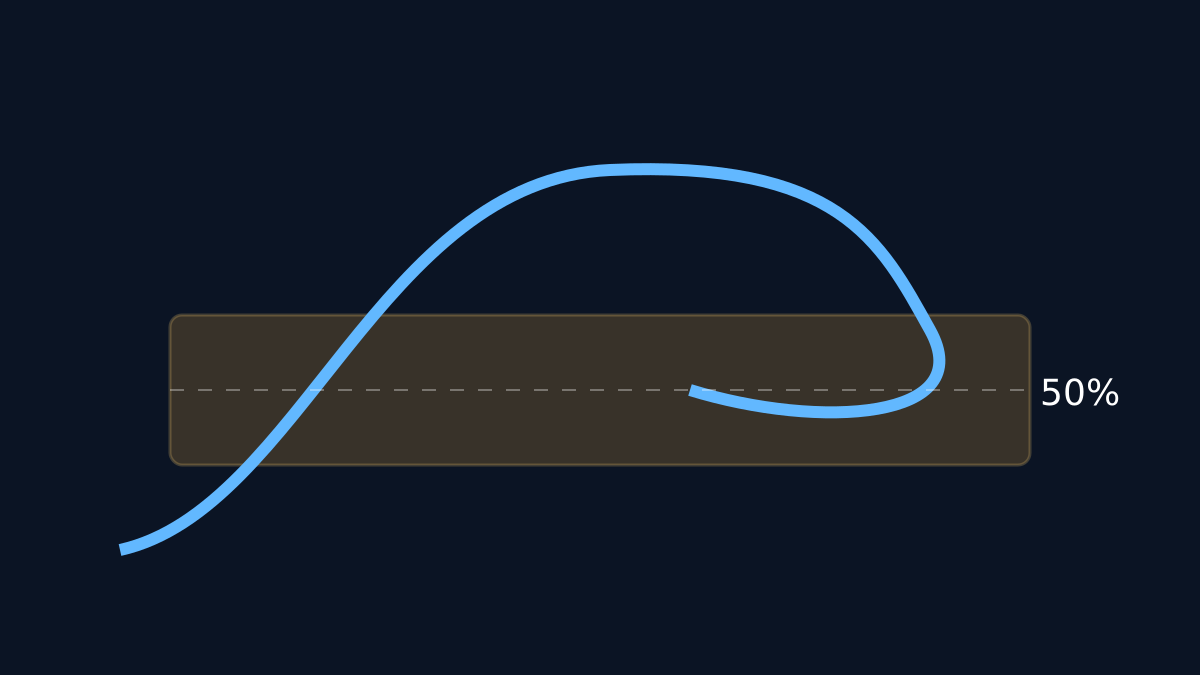
Partial fills can lead to encroachment, where price enters the gap but does not fully close it. This behavior can influence the gap's reliability as a reference point for future price action.
Liquidity, Break of Structure, and Market Structure Shifts
FVGs often coincide with areas of liquidity imbalance. They can serve as zones where stop orders accumulate, making them attractive targets for liquidity hunts. The interaction of price with FVGs frequently aligns with key market events such as Break of Structure (BOS) or Market Structure Shifts (MSS)/Change of Character (CHOCH), which signal potential trend continuation or reversal.
Premium and Discount Zones
Within the context of order blocks and fair value concepts, FVGs can be viewed as premium or discount zones relative to current price. For example, a bullish FVG below price may represent a discount area where buyers could enter, while a bearish FVG above price may be a premium zone for sellers.
Higher Time Frame (HTF) Versus Lower Time Frame (LTF) FVGs
The significance of an FVG is often proportional to the timeframe on which it forms. HTF FVGs tend to carry more weight due to the larger volume and institutional activity involved, while LTF FVGs may be more susceptible to noise and false signals. Traders should consider the interplay between HTF and LTF gaps when analyzing market context.
Continuation Versus Reversal: Interpreting FVGs
FVGs can act as catalysts for both trend continuation and reversal, depending on the broader market context. For instance, a fresh bullish FVG formed after a BOS in an uptrend may signal a continuation opportunity. Conversely, an FVG appearing near a key resistance level or after a MSS/CHOCH could herald a reversal.
Failure Modes and Limitations of Fair Value Gaps
While FVGs highlight areas of inefficiency, they are not infallible. Common failure modes include:
- False fills: Price may briefly enter an FVG without meaningful follow-through.
- Over-reliance: Treating FVGs as standalone entry signals ignores broader market structure.
- Context neglect: Ignoring HTF trends or liquidity considerations can lead to misinterpretation.
Therefore, an FVG should be viewed as a reference zone rather than a deterministic trigger.
Hypothetical Example 1: Bullish Fair Value Gap in an Uptrend
Consider a market in a clear uptrend where price rapidly breaks above a resistance level, forming three candles with the middle candle's body completely above the first and third candles' highs. This creates a bullish FVG below the current price. Subsequent retracement into this gap may attract buyers seeking a discount entry, aligning with the trend continuation. However, if the broader market shows signs of exhaustion or a MSS, the gap's reliability diminishes.
Hypothetical Example 2: Bearish Fair Value Gap at a Reversal Zone
Imagine price in a downtrend that forms a bearish FVG after a sharp decline. The gap lies above current price, representing a premium zone. If price rallies back into this FVG near a known resistance or supply zone, it may trigger selling pressure and confirm a reversal. Yet, if the overall market structure remains bearish with no BOS, the gap might simply be mitigated without a meaningful reversal.
Why an FVG Alone Is Not an Entry Signal
Despite their utility, FVGs should never be used in isolation for trade entries. They lack contextual information about momentum, volume, and broader market structure. Effective trading decisions require integrating FVG analysis with other tools such as order blocks, liquidity pools, BOS, MSS/CHOCH, and HTF trend alignment.
For a deeper understanding of related concepts, see our articles on Order Blocks Explained and Market Structure Shifts and Change of Character.
Key Takeaways
- Fair Value Gaps are inefficiency zones defined by three-candle boundaries where price has displaced rapidly.
- They can be bullish or bearish, fresh or mitigated, and vary in significance depending on timeframe.
- FVGs relate closely to liquidity, BOS, MSS/CHOCH, and premium/discount concepts.
- They can indicate potential continuation or reversal but require broader market context for interpretation.
- An FVG alone is insufficient as a trade entry signal; it must be combined with other structural and liquidity analyses.